Sleep Surface • Nursery Safety
A Nursery Sleep Surface: Understanding Organic Crib Mattress Firmness and Fit
A crib mattress is a modest object with an unusually important job. It should be firm, flat, and properly fitted to the crib—qualities more consequential than a fashionable label or an elaborate description of its materials. For caregivers considering an organic crib mattress, the useful questions begin with safety and fit, then turn to what the mattress is made of and how its claims are documented.
Published November 7, 2026
Nursery shopping has a way of making ordinary decisions feel momentous. A mattress seems to promise not only a place for a baby to sleep but, by implication, a measure of foresight: the right surface, the right fabric, the right beginning. Yet the most important features are not difficult to name. For an infant, the sleep surface should be firm and flat, the mattress should fit the crib snugly, and the sleeping space should remain clear of loose bedding and soft objects.
Those principles are straightforward. The marketplace around them is not. “Organic” may appear beside an assortment of materials, certifications, construction methods, and assurances. The word can be useful when it refers to a clearly defined material and a verifiable standard. It cannot, on its own, establish that a mattress is safer, more supportive, or suitable for every crib. A calm evaluation separates the questions: Is the product designed for the crib in question? Does it meet applicable safety requirements? Is it firm and flat? And, after those basics, do its materials and care instructions suit the household?
Firmness is a safety feature, not a comfort contest
Adults often speak of mattress firmness as a preference—plush, medium, or firm, as if choosing a hotel room. For an infant, firmness has a different significance. The American Academy of Pediatrics recommends placing babies on their backs for every sleep on a firm, flat, non-inclined surface intended for infant sleep, such as a safety-approved crib mattress, covered only by a fitted sheet. A soft surface can conform around a baby’s face or body; a firm surface is less likely to do so.
This does not mean caregivers should try to diagnose a mattress by pressing a palm into it and treating the result as a laboratory test. Nor does a marketing phrase such as “supportive” replace an actual safety standard. Instead, look for a mattress intended for the specific use, check that it is sold as a crib mattress rather than an adult product repurposed for a nursery, and consult the manufacturer’s instructions and applicable safety information. In the United States, crib mattresses are subject to federal requirements; caregivers can check current guidance from the Consumer Product Safety Commission (CPSC) and follow any applicable product notices or recalls.
Firmness is not the same as hardness in every ordinary sense. A mattress may have layers, seams, or a quilted cover and still be designed to provide a firm, flat infant sleep surface. The important point is that the finished product must be evaluated as a whole, according to its intended use and relevant standards—not inferred from one appealing ingredient. If a mattress feels conspicuously soft, has a pronounced depression, or has become uneven or damaged, stop using it for infant sleep and seek guidance from the manufacturer or a pediatric health professional.
Fit belongs to the mattress and the crib together
A mattress is not a universal rectangle floating free of its surroundings. It is one half of a fit problem; the crib is the other. A mattress that is appropriate for one crib may not fit another, even if both are described with familiar size names. Manufacturers provide dimensions and compatibility instructions for a reason. Before buying, identify the exact crib model, consult its manual, and compare the mattress dimensions and permitted types with the crib manufacturer’s specifications.
Once assembled, the mattress should lie flat and fit snugly within the crib. There should be no substantial gaps at the sides or corners, and the mattress should not buckle, bow, or ride up. Check the fit again after changing the mattress height, rotating the mattress, or moving the crib. If there is doubt about compatibility, do not try to solve it with a folded towel, extra padding, or a makeshift filler. Contact the crib or mattress manufacturer and use only a combination they identify as compatible.
Caregivers may hear informal rules for estimating gaps, including the familiar “two-finger” test. Such shorthand can be a prompt to notice a poor fit, but it should not replace the crib and mattress instructions or current official guidance. Dimensions, construction, and the way a mattress sits in a particular crib matter. The safest practical approach is to use components intended to work together, follow the manufacturer’s fit directions, and reject combinations that leave visible or persistent spaces.
What “organic” can—and cannot—tell you
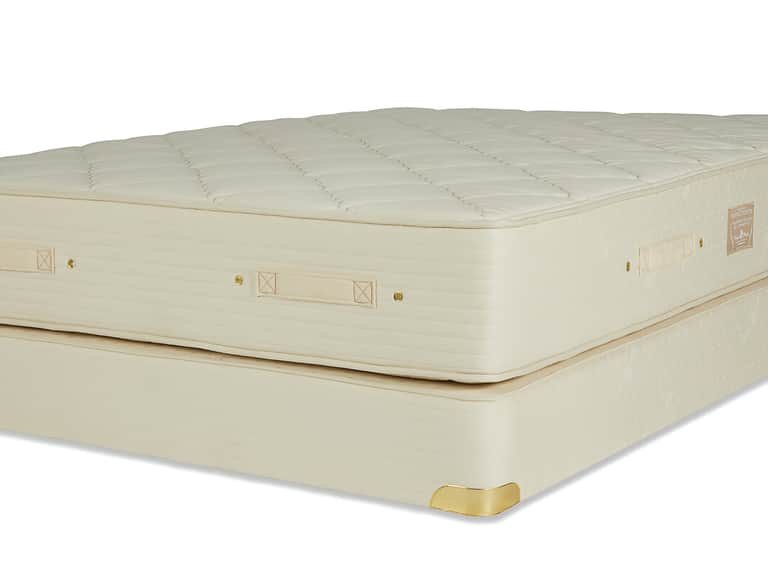
Organic crib mattresses may be made with materials such as organic cotton, wool, or natural latex, sometimes in combination with other components. The term can describe an agricultural or textile standard applied to a particular fiber, but it does not necessarily describe every part of a finished mattress. A cover, filling, barrier, adhesive, waterproof layer, and structural core may each have different material and certification details. The useful question is not merely, “Is it organic?” but, “Which materials are certified, by whom, and what exactly does that certification cover?”
Labels can be difficult to interpret because certifications differ in purpose. Some address the agricultural origin of fibers; others assess chemical emissions, processing, or restricted substances. A certification for one component should not be taken as certification of the entire product unless the certifier and documentation explicitly say so. Read the scope. Look for the name of the certifying organization, the specific standard, and a way to verify the claim. If a product description uses broad language without explaining its basis, ask the manufacturer for details.
Material descriptions are not a substitute for infant sleep safety. Organic cotton does not make an overly soft surface appropriate; natural latex does not settle a question about crib compatibility; and a promise of “chemical-free” is too broad to be informative without a precise definition. Every physical material consists of substances, and product safety depends on design, manufacturing, exposure, standards, and intended use. A careful shopper can value material transparency without treating an environmental or textile claim as proof of a medical benefit.
A closer look at Naturepedic and category comparisons
Naturepedic is a name caregivers may encounter while researching organic crib mattresses. As with any maker, the sensible approach is to examine the model rather than assume that a brand name answers every question. Product lines can differ in dimensions, construction, cover materials, waterproofing, certifications, and care requirements. A description of one mattress should not be generalized to every mattress sold under the same name.
When comparing Naturepedic models or other options in the Organic Crib Mattresses category, begin with the model’s intended use and stated dimensions. Confirm that it is designed for a crib of the relevant type and that the crib manufacturer permits that mattress. Then review the construction: the materials in the core and cover, the nature of any waterproof barrier, the seams and edges, and any instructions about cleaning or rotation. If the manufacturer lists certifications, check which component or finished product each one covers. Clear, specific documentation is more helpful than a long list of reassuring adjectives.
Some caregivers prefer a waterproof surface because spills and diaper leaks are inevitable features of domestic life. Others prioritize particular fibers or manufacturing standards. These are reasonable preferences to weigh after fit and safety have been established. The practical question is whether the chosen product can be cleaned and maintained according to its instructions without adding an unapproved cover or altering the sleep surface. If a waterproof layer is built into the mattress, understand how the manufacturer says to clean it. If a separate protector is proposed, verify that it is specifically allowed for that mattress and crib; do not assume that a generic pad is harmless simply because it is thin.
Keep the sleep space simple
Once the mattress is installed, the safest arrangement is also the least decorative. Use a fitted sheet designed to fit the mattress and keep the crib free of pillows, quilts, comforters, stuffed toys, positioners, and loose blankets. These objects can look like signs of care and welcome, but an infant sleep space is not a miniature adult bed. Soft items and loose bedding can create hazards, and they are not necessary to make the crib feel inviting.
For warmth, follow pediatric safe-sleep guidance and dress the baby appropriately rather than adding loose bedding. Wearable blankets may be an option when used according to their directions and the child’s developmental stage. Weighted sleep products should not be used for infants. Keep the mattress level and use the crib’s approved configuration; do not incline it to address reflux or congestion unless a qualified clinician has given specific instructions, and never improvise a wedge or prop.
Safe sleep recommendations apply to naps as well as nighttime sleep. Babies should be placed on their backs for each sleep, even when they are known to roll in other circumstances. As children develop, follow current pediatric guidance and the instructions for the crib’s mattress height and conversion features. When a baby can sit, pull up, or otherwise reach a new developmental stage, the crib’s configuration may need adjustment according to its manual.
A practical evaluation checklist
Rather than trying to rank mattresses by a single appealing feature, caregivers can use a short sequence of questions. It makes the decision more manageable and helps keep marketing language in its proper place.
- Is it intended for infant sleep? Confirm that the product is a crib mattress, not an adult mattress or a general-purpose pad.
- Does it meet applicable requirements? Review the safety information and check current CPSC guidance, including any recall notices relevant to the model.
- Does it fit this exact crib? Compare the mattress dimensions and type with the crib manual and manufacturer’s compatibility instructions.
- Is the finished surface firm and flat? Look for a stable, even surface without sagging, damage, or unusual softness.
- What does “organic” refer to? Identify the material, certification, standard, and scope rather than relying on a general claim.
- How should it be cleaned? Follow the manufacturer’s instructions and avoid unapproved covers, pads, or treatments.
- Is the product current and intact? Check labels, model information, recalls, and condition, especially when considering a used mattress.
Secondhand products deserve particular caution. A used mattress may have an unknown history of spills, storage, cleaning, or wear. It may no longer fit as intended, and its construction or model information may be difficult to verify. If considering one, consult current public-health guidance and the manufacturer’s instructions; do not use a mattress that is damaged, sagging, missing identification, or incompatible with the crib. A new fitted sheet does not restore a worn or unsuitable sleep surface.
When a question belongs with a professional
Product descriptions can answer questions about dimensions, materials, and care. They cannot diagnose a baby’s health or determine whether a particular sleep arrangement is appropriate for a medical condition. If an infant has a health concern that seems to require a special surface, inclined position, or device, ask the child’s pediatric clinician before making a change. In most cases, a product marketed as a solution for reflux, breathing, or “better sleep” should not override established safe-sleep recommendations.
For questions about a mattress’s composition, ask the manufacturer for written, model-specific information. For questions about a crib’s compatibility, consult the crib manual or its maker. For safety alerts, check official sources rather than relying only on retailer descriptions or social-media posts. The best answers are concrete: model numbers, measurements, standards, and instructions—not assurances that a product is “perfect” for every baby.
The quieter measure of a good choice
There is an understandable temptation to believe that the most carefully named materials will guarantee the most peaceful night. But the promise of sleep is not something a label can deliver. A well-chosen crib mattress is valuable because it performs its particular task unobtrusively: it fits the crib, remains firm and flat, and can be used as directed. Organic materials may matter to a family’s priorities, and transparent sourcing can help them make an informed choice. Neither displaces the fundamentals.
In the nursery, safety often looks less like an elaborate purchase than a sequence of small, verifiable decisions. Measure the crib. Read the manual. Confirm the model. Make the surface simple. Place the baby on their back. If the material claims matter, inspect the evidence behind them. Then let the room become what it was meant to be—not a showroom of promises, but a calm place in which the essentials have been considered and the rest can wait until morning.
Important: This article is general educational information, not medical advice. Safe-sleep recommendations and product standards can change. Consult your child’s pediatric clinician and current guidance from trusted authorities, including the American Academy of Pediatrics and the U.S. Consumer Product Safety Commission.